

Despite having made good inroads into the hakea infestation of the Bergfontein valley in our well-attended March and June 2021 hacks, there was still plenty more of the aggressive Australian invader, hakea sericea, remaining. Black wattles, although more confined to lower altitude areas, also remain a threat to the valley. So, before 2022 ran out on us, we managed our next hack on Saturday 10 September, kindly hosted by Adam van Nieuwenhuizen and his mother Bettie on the Bergfontein farm, where the evening before we camped in the wonderful setting around the Bergfontein farm house.
There was a good turnout of 19, including MCSA members, our host Adam and two neighbouring landowners, Chris Davies and Theresa Assad and friends, as well as Adrian Fortuin of Cape Nature with a large group who helped a great deal to swell the youth and energy of our team! The Gourtiz Cluster Biosphere Reserve (GCBR) kindly sponsored some herbicide to use on the wattles – thanks GCBR.
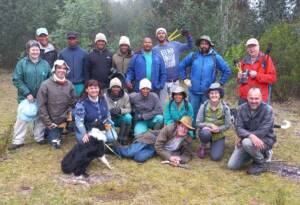
The team at our Bergfontein farm base camp.
(Photo by: Chad Henning)
A conservative estimate is that we cleared at least 2 000 mainly young hakea and wattle trees from an area of about 70 hectares. As before, a lot of our time was spent hunting for the widely scattered individual trees and tree clusters across the steep terrain, sometimes through tall, dense fynbos vegetation. So, once again there was plenty of good cardio-vascular work-out opportunities to be had!
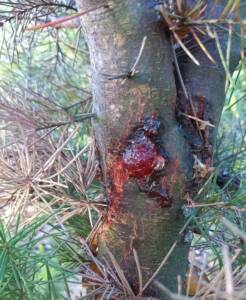 A hakea tree from a lower altitude area in the Bertgfontein valley, seen with oozing gum – a typical symptom of infection by the gummosis fungus
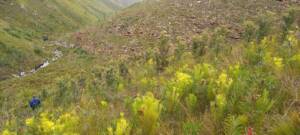
Young hakea trees in one of the higher altitude areas where we cut
It was encouraging to see that especially in the lower altitude areas, some hakea clumps were heavily infested with the gummosis fungus, with many in a poor state of health and some plants already dead. We did not cut down the trees in these clumps, but left them as a nucleus for further infection and to see how the infection progressed. CapeNature recorded the GPS coordinates of these heavily infested clumps so that they can be located to monitor in the future.
As the MCSA South Cape Section, we hope to continue assisting local landowners and Cape Nature effectively control the invasive alien plants in the upper Bergfontein River catchment, which is in a strategically important location between some large hakea infestations to the east and extensive areas to the west which are largely free of hakea.
Meet Leader ~ Donovan Kotze